
I Thought I Was Watching a Drone Crash: It Was Just Venus Being a Glitch
Learn how to distinguish atmospheric distortion from satellites through a firsthand account of mistaking Venus’s crescent phase for a malfunctioning drone.


It was 8:15 PM on Tuesday, March 14th, 2026, and I was standing in my backyard in Portland, holding a lukewarm cup of coffee and staring at what I was convinced was a quadcopter about to crash into my neighbor’s shed.
To my left, the familiar constellations of winter were dipping below the tree line, but my eyes were locked on a single, searing point of light low in the west. It wasn't twinkling serenely like the stars overhead. It was vibrating. It seemed to stretch vertically, then collapse into a blur, flashing rapid spikes of red and blue that looked suspiciously like navigation lights failing.
I’ve been writing about the sky for years, but in that moment, professional curiosity took a backseat to genuine confusion. My brain categorized the object as "artificial" and "broken." I spent ten minutes scanning for the sound of rotors or the trajectory of a falling object. It held perfectly still in the sky, suspended in the turbulent air above the horizon, mocking my logic.
What I was actually seeing was Venus. Not just Venus, but Venus approaching its greatest illuminated extent—a phase where the planet is a razor-thin crescent to our eyes but so massive and close that it reflects more light toward Earth than at any other time. The "glitch" wasn't a mechanical failure. It was a lesson in atmospheric optics and how our own expectations can trick us into seeing technology where there is only physics.
When a Planet Looks Like a Broken Lightbulb
The confusion began because the object simply didn't behave like a celestial body is "supposed" to. We are conditioned to expect stars to be steady, faint pinpricks and planets to be steady, bright disks. This thing was violent.
At an altitude of roughly 15 degrees, Venus was shining through a thick slice of Earth’s atmosphere. When you look straight up, you are looking through about 10 miles of air. When you look near the horizon, that thickness increases significantly. The atmosphere acts like a fluid lens, with layers of varying temperature and density bending light rays. This is refraction. When those layers move and mix, the light shimmers—a phenomenon astronomers call "seeing."
For a point-source like a distant star, bad seeing turns the object into a sparkling mess. But Venus at this time of year isn't a point source. Even without a telescope, it is discernible as a tiny disk. The atmosphere was treating this disk like a prism, separating the white light into its constituent colors. The red and blue flashes I saw weren't navigation lights; they were chromatic aberration caused by the turbulent air splitting the planet's image.
I see this same confusion frequently when people try to spot planets close to the horizon. It is a specific problem with low-altitude observing. If you have ever tried to follow the step-by-step guide to spotting Mercury 15 minutes after sunset, you know that Mercury can look just as erratic. The closer a planet is to the heat-radiating earth, the more it appears to dance, shimmer, and change color.
The Binocular Test That Saved My Sanity
After ten minutes of staring at the "drone," I did what any skywatcher should do when their eyes fail them: I grabbed my 10x50 binoculars. I didn't go for my telescope yet; I just needed a little more optical grasp to resolve the shape.
Bringing the binoculars to my eyes required a steady hand, because the target was so low. I propped my elbows against the fence. The image steadied, and the "glitch" instantly snapped into focus. The erratic flashing resolved into a sharp, unmistakable geometry. It wasn't a circle. It was a slender, glowing crescent, looking remarkably like a tiny, distant capital letter "C".
Seeing the phase of Venus with your own eyes—using just modest binoculars—is a powerful experience. It connects you directly to the history of astronomy. Galileo saw this same shape in 1610 and used it to prove that the planets orbit the Sun, not the Earth.
But in that moment, it served a more practical purpose. The crescent shape proved I was looking at a body illuminated by an external light source (the Sun) from an angle. Drones and satellites have their own lights or are lit by the sun in ways that don't produce a clean, uniform crescent shadow like this. The "glitch" was just the atmosphere smearing that crescent around. It was a natural phenomenon behaving badly, not a machine behaving dangerously.
Why a Crescent Can Be Brighter Than a Full Disk
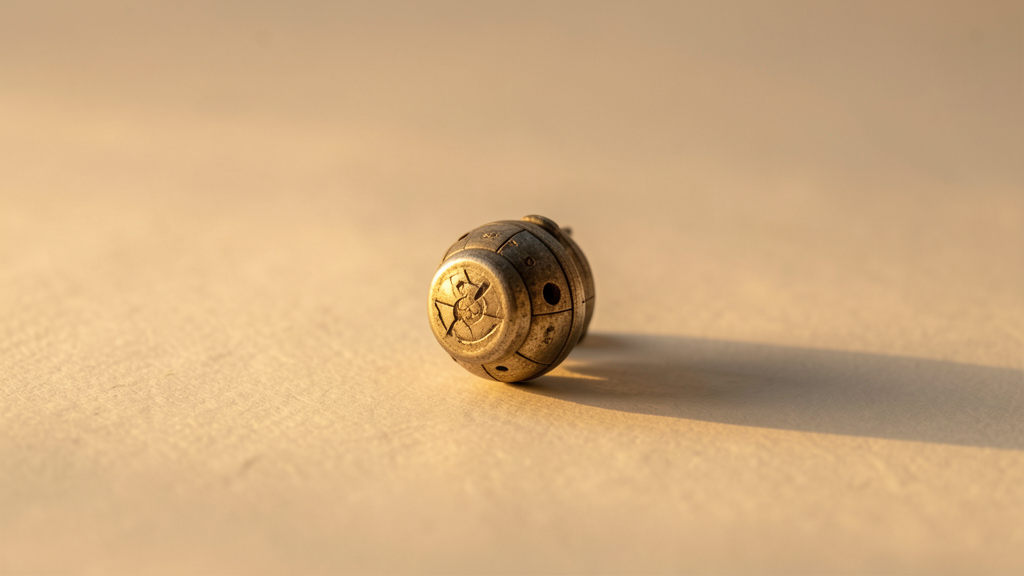
Here is the trade-off that makes Venus such a trickster. As Venus catches up to Earth in its faster orbit, it gets closer and therefore appears larger in our sky. However, as it gets closer, it also moves into a phase where the sunlit side facing away from us, turning from a "full" planet into a half, then a crescent.
Logic suggests a crescent should be dimmer than a full disk, right? You are seeing less of the lit surface.
But Venus is weird right now. We are seeing a huge, razor-thin slice of the planet. The sheer amount of reflective surface area, combined with the proximity to Earth, means that the total amount of light hitting our retinas is actually maximized during this crescent phase. This is the "greatest illuminated extent."
That explains why the light was so piercing. It wasn't just a bright star; it was a planet acting like a searchlight. This intensity exacerbates the atmospheric effects. The brighter the source, the more aggressive the "glitching" appears when the air is turbulent.
It reminds me of the frustration many feel when viewing other planets. People often expect to see the vivid, swirling colors of Jupiter or the deep red rust of Mars exactly as they appear in Hubble photos through their backyard telescopes, but they are often met with a blurry, pale disc. The atmosphere is the enemy of detail. Venus in 2026 is the exception where the brightness actually adds to the drama, even if it ruins the stability.
My Protocol for "Unknown" Sky Objects
This experience forced me to refine how I identify unknown lights. I’ve formalized it into a mental checklist that I now use whenever I see something that looks "artificial." It saves you from checking news feeds for UFO sightings or calling the local airport.
1. The Lock-and-Wait Rule Artificial objects move. Satellites traverse the sky in minutes. Drones drift or hover with purpose. True celestial objects are "locked" to the background stars. If I stare at the object for 60 seconds and its position relative to the trees or rooftops hasn't changed, it is almost certainly celestial. The "glitching" I saw was violent, but the position was absolute.
2. Defocus Your Eyes or Optics If you are viewing a star with binoculars or a telescope and you defocus the image slightly, it turns into a symmetrical donut of diffraction spikes (Airy disk). If you defocus a planet like Venus or Jupiter, it stays a blob. It doesn't spike like a star. If you defocus an artificial light (like a distant LED streetlamp), it often takes on the shape of the lens aperture or looks jagged. When I defocused Venus that night, the "glitch" smoothed out into a soft, wide glow—confirming it was a broad source of light, not a point.
3. Check the Color Spectrum Stars twinkle. Planets usually shine with a steady light. However, low planets flicker violently with color. If the object is flashing distinct reds and blues and is low on the horizon, it is likely a bright star (like Sirius) or a planet (like Venus or Jupiter) being distorted by the atmosphere. Aircraft and drones have specific blinking patterns (red/green/white) that are rhythmic. The chaotic, multicolored shimmer I saw was the fingerprint of atmospheric refraction, not aviation electronics.
The Satisfaction of Solving the Puzzle
By 8:30 PM, the "crashing drone" had dropped behind the distant ridge of trees, finally setting. My coffee was cold, but my adrenaline was up. I hadn't witnessed a catastrophe. I had witnessed the geometry of the solar system playing out through a layer of turbulent air.
The real takeaway isn't just about Venus. It is about understanding that the sky is not a static wallpaper. It is a dynamic environment with bad seeing, optical illusions, and perspective tricks that can confuse even seasoned observers.
Venus will continue to dominate the evening sky for the rest of the spring, moving higher and gradually becoming less of a crescent and more of a "half-moon" shape by late May. As it gains altitude, the "glitching" will lessen. The air will be steadier higher up, and the frantic flashing I saw in mid-March will settle down into a steady, majestic glow.
Next time you see a light near the horizon that looks like it’s short-circuiting, don't assume it's a drone. Grab your binoculars, steady your hands, and look for the crescent. You might find that the sky is putting on a show that is infinitely more interesting than a machine.
Read next
The Red Planet Reality Check: Why Your View of Mars Won’t Match the Magazines
Manage your expectations for the next opposition by understanding the physics behind why Mars remains a small, rusty orb in your eyepiece, and learn to love the subtle details you can actually spot.

The 15-Minute Window: How to Finally Catch Mercury After Sunset
Master the narrow 15-minute post-sunset window to locate Mercury using a precise scanning technique that bypasses the horizon glare.