
How to Align Your Telescope’s Finder Scope in 3 Minutes During the Day
Stop chasing the Moon across a black sky; learn to align your finder scope using a distant terrestrial target in broad daylight for a frustration-free night.


We have all been there. It is a clear night, the Moon is looking spectacular, or perhaps Jupiter is rising near the horizon. You rush outside with your telescope, eager to get a glimpse. You point the tube roughly where you think the object is, peer through the finder scope, and see... nothing. You pan left, nothing. You pan right, still nothing. Eventually, you look through the main eyepiece only to realize you have been staring at a patch of empty black sky three degrees away from your target.
This frustration kills the stargazing mood faster than a cloud bank. The issue is almost certainly that your finder scope is misaligned. This small, wide-angle telescope mounted on the side of your main tube is supposed to help you locate objects, but if it is not perfectly synced with your main optics, it is useless.
Most beginners make the mistake of trying to fix this alignment in the dark, struggling to find a bright star or planet to center. That is the hard way. The absolute best time to align your finder scope is during the day, using a fixed terrestrial target. You have light, you have contrast, and you have distinct landmarks. Here is how to get it done in under three minutes.
Why Daylight Alignment Saves Your Sanity
Aligning optics at night is an exercise in patience you do not need. In the dark, you lack reference points. You are trying to center a point of light that you cannot easily identify against a field of other points of light. Furthermore, your night vision makes it difficult to see the crosshairs or the adjustment screws on your finder bracket.
During the day, the situation flips entirely. You can pick a target that does not move, like the top of a utility pole or a specific branch on a distant tree. You can see your equipment clearly. If you bump the telescope, you know exactly how much you moved it. By doing this chore while the sun is up, you guarantee that when the stars come out, your telescope is actually pointing where you think it is.
Before we begin, ensure your telescope is on a stable mount. A wobbly tripod will make this process impossible. If you are struggling with a flimsy mount that vibrates every time you touch it, you might be dealing with the kind of hardware I often warn against. I recently discussed the pitfalls of shaky, entry-level setups in The $200 Department Store Telescope I Returned (and What I Bought Instead). Stability is the foundation of sharp images and accurate alignment.
Step 1: Secure Your Mount and Start Low
Set up your telescope on a flat surface, ideally concrete or pavement, to prevent sinking. Extend the tripod legs only as much as necessary; a lower center of gravity is more stable. Lock the altitude and azimuth knobs tight.
Insert your lowest magnification eyepiece into the focuser. This is usually the one with the highest number printed on it, typically a 20mm or 25mm. A low magnification eyepiece provides a wide field of view, making it much easier to locate your target initially. Do not start with a high-power eyepiece, or you will be staring at a blur trying to find a distant chimney.
If your telescope uses a reflector design, remember that the image will be upside down and reversed left-to-right. Refractors with a diagonal will correct the image to be right-side up but usually mirror it left-to-right. Keep this orientation in mind so you do not instinctively move the telescope in the wrong direction.
Step 2: Pick a Distant Landmark
This is the step where most people go wrong. Your target needs to be as far away as possible. Ideally, choose something at least 200 to 300 meters away. If you pick a neighbor's roof tree that is only 20 meters away, your telescope will be focused too closely, and the parallax error between the main tube and the finder scope will throw off your alignment as soon as you try to focus on a star at infinity.
Good targets include:
- The top of a telephone pole or transformer.
- A church spire or tall building antenna.
- A distinct street sign.
- A shiny metallic object on a distant rooftop.
Avoid targets that move, like cars or clouds. Once you have selected your mark, use the telescope’s slow-motion control cables or manual knobs to center the target precisely in the middle of your main eyepiece’s field of view. Spend a moment tweaking the focus knob until the edges of the object are crisp. The sharper the image, the better your alignment will be.
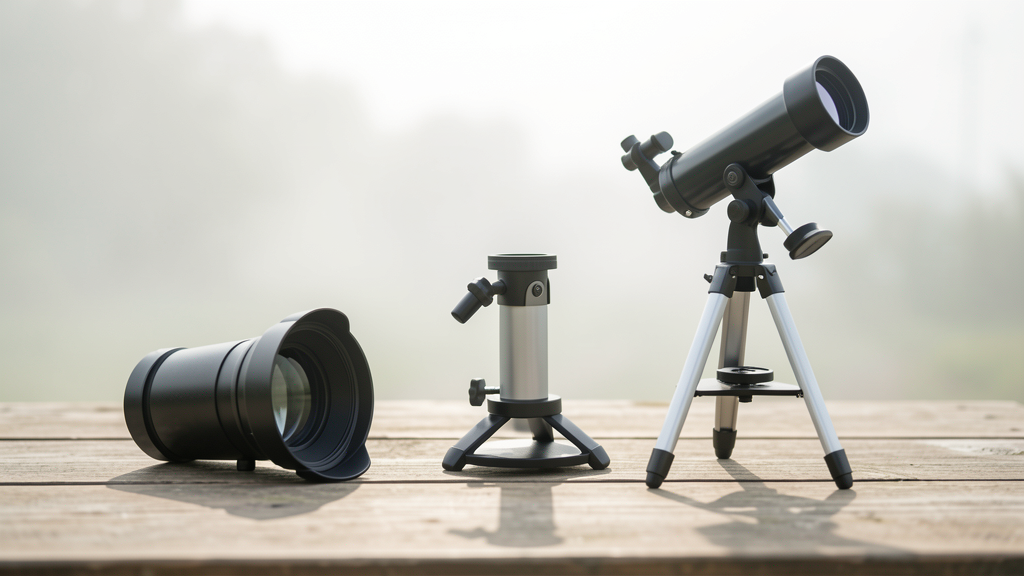
Step 3: Center the Target in the Main Eyepiece
With the target locked in your main telescope, do not touch the main tube again. This is critical. The main scope is now your "master" reference. The rest of the job involves adjusting the finder scope to match the main tube, not the other way around.
Look through the eyepiece one last time to ensure the target is dead center. If you have a reticle eyepiece (one with crosshairs), place the intersection exactly on the target point. If not, use your best judgment to place it in the geometric center of the view.
If you are using a Go-To telescope, this is also the moment you might initialize the system, but for manual alignment, simply holding the position steady is enough. Lean gently against the tripod to dampen any vibrations before moving to the next step.
Step 4: Adjust the Finder Scope Without Moving the Tube
Now, move your eye to the finder scope. You will likely see your target, but it will be off-center, perhaps near the edge of the field of view or completely out of the picture.
On the finder scope bracket, you will see either three or six small screws surrounding the tube. These are the adjustment screws. They push against a small ring or O-rings that hold the finder scope in place. This is a delicate system—do not unscrew them all the way, or the finder scope will fall out.
Gently turn the screws one by one. The goal is to nudge the finder scope’s image toward the center. If the image needs to go up, tighten the bottom screw (or loosen the top one, depending on the bracket design). It is usually a process of "pushing" the finder scope using the screws against the spring tension of the O-rings.
Go slowly. A tiny turn of a screw can move the view significantly. Check the main eyepiece after every few adjustments to ensure you haven't bumped the telescope. If the main view shifts, re-center it before continuing with the finder.
Iterate this process until the target in the finder scope is perfectly aligned with the target in the main eyepiece. You want the object in the finder to be in the exact center of its field of view, right where the crosshairs meet if you have them.
What If Your Image is Upside Down?
A common point of confusion involves the orientation of the image. If you are using a standard Newtonian reflector, both your main telescope and your finder scope will produce upside-down images. This makes alignment intuitive because "up" in the finder is "up" in the main scope.
However, if you have a refractor with a star diagonal, your main view might be right-side up, while your finder (which often lacks a diagonal) is upside down. In this case, moving the adjustment screw to push the image "up" in the finder might actually correspond to moving the target "down" in the main scope.
If you find yourself getting confused by the direction, stop and think logically about the geometry. Imagine physically pushing the back of the finder scope tube. Which way does the front move? That is the direction the image will shift. Visualizing the physical mechanics often helps faster than trying to interpret the visual cues.
The Final Check Before Dusk
Once you think you have nailed it, look away for a moment and then return to both eyepieces to verify alignment with fresh eyes. It is easy to convince yourself it is "good enough" when you are eager to finish. Good enough usually results in having to hunt for the Ring Nebula for twenty minutes later tonight.
When you are satisfied, tighten the locking thumbscrew on the finder scope bracket to ensure it does not slip. Be careful here—overtightening this thumbscrew is the number one cause of alignment shifting. You just want it snug enough to hold the weight, not tight enough to crush the metal.
You are now ready for the night. When you take the telescope outside, simply point the finder at a bright star or planet. If your alignment held, that object should be in the field of view of your main eyepiece immediately, perhaps needing just a minor nudge with the slow-motion controls.
As you transition from day to night, remember to protect your night vision. Avoid looking at your phone screen and switch to a proper astronomy flashlight. I explain why this is vital in 4 Reasons Why a Cheap Red Flashlight Will Ruin Your Night Vision. Preserving your dark adaptation ensures that once you find your target, you can actually see the faint details you came for.
From Setup to Observation
Completing this alignment ritual changes the entire dynamic of your observing session. You move from a hopeful hunter to a confident navigator. The three minutes you spend in the backyard this afternoon save you thirty minutes of frustration tonight. That time is better spent actually observing the rings of Saturn or the craters of the Moon rather than wrestling with hardware.
This process highlights a fundamental truth in amateur astronomy: the gear serves the experience, but only if it is treated with care. Regular maintenance, including simple alignment checks, transforms a frustrating instrument into a reliable window to the universe. Get the alignment right, and the sky is no longer a vast, empty searching ground—it becomes a map you know how to read. If you are looking for more tips on optimizing your kit, check out our other resources in the stargazing-tools category.
Read next
Why Did I Return My $200 Department Store Telescope?
Discover why a cheap, high-magnification department store telescope failed to deliver views of the cosmos and which stable, beginner-friendly instrument replaced it.

4 Reasons Why a Cheap Red Flashlight Will Ruin Your Night Vision
Saving a few bucks on a red flashlight might cost you the best view of the Milky Way you'll get all year.